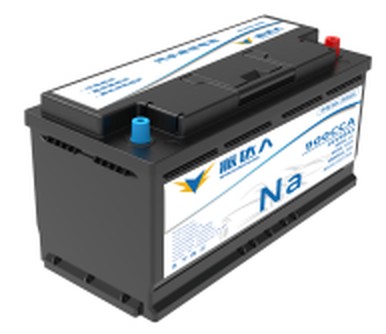
12V & 24V Sodium-Ion Starter Battery
Sodium-ion (Na-ion) starter batteries for cars, motorcycles, trucks, construction equipment and marine use. The reason to look at sodium rather than lithium for starting duty is low temperature: a lead-acid battery loses most of its cranking capability below -20℃, and a LiFePO4 pack will not accept charge below 0℃ without pre-heating. A sodium-ion pack delivers cranking current down to -40℃ with no heater and no warm-up cycle.
Battery ESSSodium-IonStarter Battery
Key Features
Cold cranking without pre-heating
Sodium-ion chemistry retains usable capacity and delivers cranking current at -40℃. No block heater, no battery blanket, no waiting for a warm-up cycle before the engine turns over — relevant for northern Europe, Russia, Canada, and high-altitude sites.
Ship and store at 0 V
Unlike lithium packs, a sodium-ion cell can be fully discharged to 0 V without damage. This makes transport, long-term warehousing and seasonal storage far simpler, and it removes the state-of-charge restrictions that apply to lithium in air freight.
Weight saving over lead-acid
Roughly 40-50% lighter than an equivalent lead-acid starting battery. On motorcycles, small plant and marine installations the saving is noticeable in handling and fuel.
Low self-discharge for seasonal vehicles
Self-discharge is under 3% per month — up to a year of standby — so vehicles that sit for weeks or months, from motorcycles and boats to construction machinery and backup generators, still start when they are needed.
Stable raw-material cost
Sodium is abundant and geographically widespread, so pricing is not exposed to lithium or cobalt price swings. For fleet tenders quoted months ahead, this makes budgeting more predictable.
Technical Specifications
| Chemistry | Sodium-ion (Na-ion) |
|---|
| System voltage | 12 V (single pack); 24 V (two 12 V packs in series) |
|---|
| Capacity range | 12 V: 50 Ah (documented); 24 V: 100 Ah; other 12V capacities on request |
|---|
| Cranking performance | Peak cranking 800 A @1s (12V 50Ah) / 1,000 A @1s (24V 100Ah); rated for -40℃ cranking |
|---|
| Operating temperature | -40℃ to 80℃ — cranking without pre-heating |
|---|
| Cycle life | >6,000 cycles @ 80% DOD; ≥100,000 engine start-stop cycles |
|---|
| Self-discharge | <3% per month — up to one year standby |
|---|
| Ingress protection | IP65 |
|---|
| Energy density (cell) | Typical sodium-ion: ≈76–81 Wh/kg at pack level (≈100–140 Wh/kg cell level) — lower than LiFePO4 |
|---|
| Weight | 12V 50Ah ≈8.0 kg; 24V 100Ah ≈30.0 kg |
|---|
| Dimensions | 12V 50Ah: 244 × 176 × 190 mm; 24V 100Ah: 522 × 240 × 218 mm |
|---|
| Terminal / form factor | JIS (36B20 / 46B24 / 55D23 / 70D23 / 80D26) and DIN (H5–H8) footprints |
|---|
| Certification | UN38.3 compliant; cells to UL1642 / IEC62133-2; UN transportation test summary (T.1–T.8) supplied with shipment — request a copy at sales@xgwtech.com |
|---|
Documented configurations
| Model | Voltage | Capacity | Energy | Peak cranking @1s | Dimensions (L×W×H) | Weight | Typical use |
|---|
| XGW-SN-12V50 | 12 V | 50 Ah | 610 Wh | 800 A | 244 × 176 × 190 mm | 8.0 kg | Cars, motorcycles, powersports |
| XGW-SN-24V100 | 24 V | 100 Ah | 2,440 Wh | 1,000 A | 522 × 240 × 218 mm | 30.0 kg | Trucks, construction equipment, marine |
Other 12V capacities (20–60 Ah) and additional 24V sizes are available on request; cranking current (CCA-class) is confirmed per model. All models: sodium-ion (Na-ion), IP65, charge -20℃–55℃ / discharge -40℃–80℃.
Applications
Passenger cars & light vehicles
Direct lead-acid replacement in 12 V systems.
Motorcycles & powersports
Weight saving plus reliable cold starts after long storage.
Trucks, buses & construction equipment
24 V systems, high vibration environments.
Marine
Starting and onboard house loads; tolerates long off-season storage.
Gensets & backup plant
Reliable starting after months of standby.
Sodium-ion vs Lead-acid vs LiFePO4 Starter Battery
Starter duties need cold-crank current and a long shelf life. Sodium-ion enters where temperature and cycle life matter most.
Sodium-ion vs lead-acid vs LiFePO4 starter
| Cold crank | Strong at low temp | Weak when cold | Good |
|---|
| Weight | Light | Heaviest | Light |
|---|
| Cycle / shelf | Long, low self-discharge | Short, sulphation | Long |
|---|
| Best for | Cold-climate, cyclic | Legacy cheap | General |
|---|
Pick sodium-ion starter for cold-climate or frequently-cycled duty where lead-acid fails early. Browse the full motive and storage range in the Battery & ESS hub.
Frequently Asked Questions
Why choose sodium-ion over lithium for a starter battery?
Low-temperature behaviour is the main reason. A LiFePO4 starter pack will not accept charge below 0℃ and needs a heater or a warm-up cycle in cold climates. Sodium-ion can be charged and discharged at much lower temperatures, and for a vehicle that has to start on a winter morning that matters more than energy density.
Can a sodium-ion starter battery replace lead-acid directly?
In most 12 V and 24 V systems yes, provided the charging system's voltage window is compatible. Sodium-ion has a different voltage curve from lead-acid, so we recommend checking the alternator regulator set-points with us before a fleet-wide swap. We can supply the charging profile for your vehicle platform.
Is sodium-ion safe to ship?
One of the practical advantages is that a sodium-ion cell can be discharged to 0 V for transport, which removes the state-of-charge limits that apply to lithium batteries in air and sea freight. UN38.3 test documentation is still required — we provide it with the shipment.
How does the cycle life compare with LiFePO4?
Sodium-ion cycle life is generally shorter than LiFePO4. This is a real trade-off, and we state it plainly rather than quoting best-case numbers. For starting duty the battery is shallow-cycled most of its life, so calendar life and cold-cranking performance are usually the deciding factors rather than deep-cycle count.
Is the energy density lower than lithium?
Yes. Sodium-ion cells are typically ≈76–81 Wh/kg at pack level (≈100–140 Wh/kg at cell level) versus 150–160 Wh/kg for LiFePO4. For a starter battery that sits in one place and is chosen for cranking performance, the density difference is rarely the limiting factor — but we would rather you hear it from us than discover it later.
Related Products