
384V 200Ah LiFePO4 UPS Battery for Hospital Critical Power in South Africa
The Challenge
- A South African hospital relied on VRLA strings for UPS-backed critical power feeding operating theatres, ICUs and life-support systems. Grid instability and high ambient temperatures were accelerating VRLA degradation, and the facilities team had no cell-level visibility into battery health until a string was already weak.
- For a hospital, even milliseconds of power loss to critical circuits is unacceptable. The replacement had to integrate with the existing UPS host, report real battery state to the monitoring system, and be delivered and commissioned as a coordinated multi-unit batch.
The Solution
- We supplied 384V 200Ah LiFePO4 battery strings — 120 cells in series, 76.8 kWh per string — built to drop into the UPS DC bus voltage window. Each string is a direct replacement for the existing VRLA bank: same nominal voltage band, same cabinet footprint, no change to the UPS itself. The packs are built with Grade-A LiFePO4 cells from Tier-1 suppliers (CATL, BYD, EVE).
- The BMS was configured to speak the UPS host's protocol (Modbus RTU/TCP over RS485, with CAN as an alternative), so the UPS reads real SOC, SOH, cell voltages, temperatures and alarm states directly. Facilities teams see battery health in real time instead of discovering a weak string during an outage.
- All packs are UN38.3 certified for safe transport and deployment, and the BMS derates charge current as cell temperature rises to protect cycle life through South Africa's high-ambient summers.
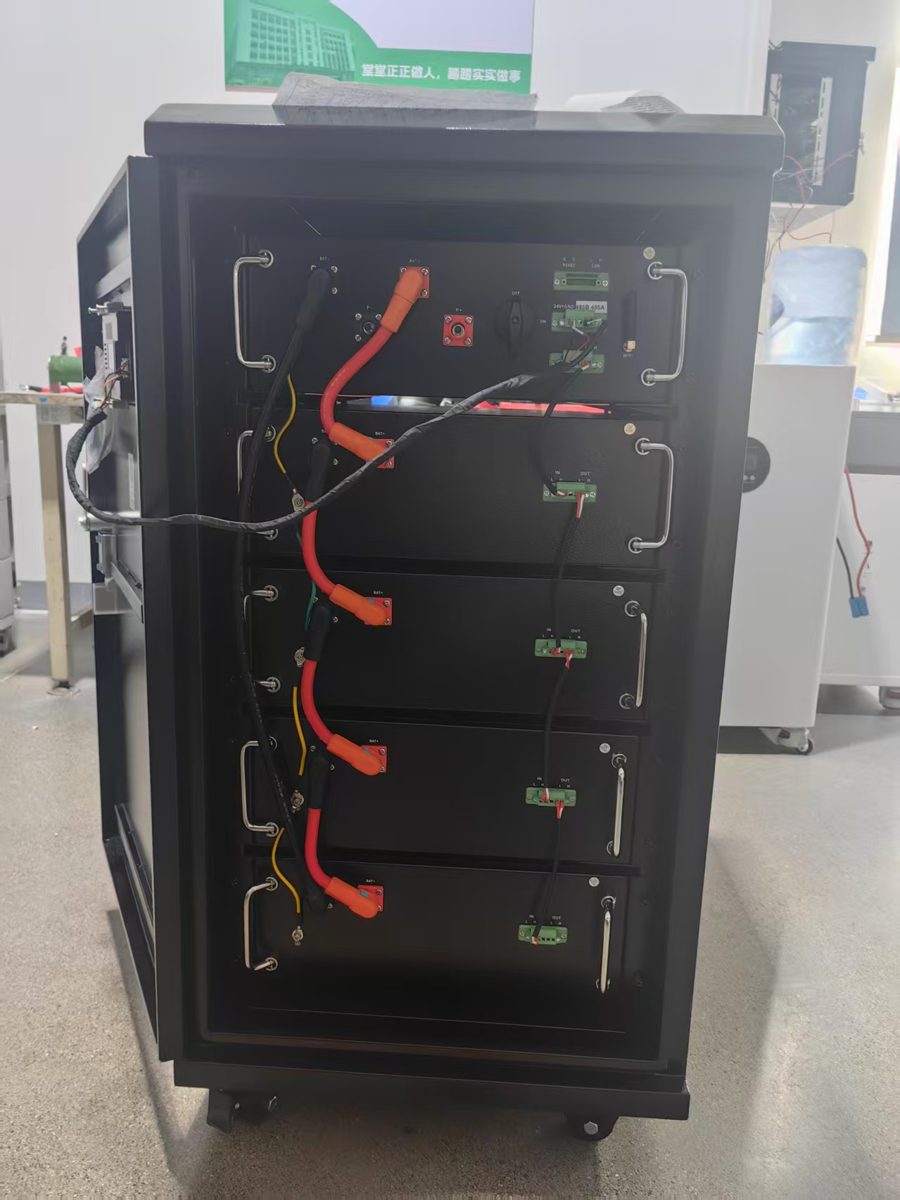
VRLA Baseline vs LiFePO4 (200Ah)
| Item | Typical VRLA bank | LiFePO4 as supplied (200Ah) |
|---|---|---|
| Chemistry | VRLA lead-acid | LiFePO4 (CATL / BYD / EVE Grade-A) |
| Nominal voltage | 384V DC | 384V DC (120S LiFePO4) |
| Capacity | 200 Ah | 200 Ah (76.8 kWh per string) |
| Communication with UPS host | Terminal voltage sensing only | Modbus RTU-TCP over RS485, CAN optional |
| Data available to UPS | Terminal voltage only | SOC, SOH, cell voltage, cell temperature, alarms |
| Transport certification | n/a | UN38.3 |
Results
- Deployed in 5-unit batches across hospital sites, with a total installed capacity of approximately 384 kWh per site (5 × 76.8 kWh strings).
- Battery state is reported straight into the UPS and monitoring platform, so the facilities team sees cell-level health in real time rather than during a failure.
- The LiFePO4 pack tolerates high-ambient summers through BMS-managed charge derating, protecting cycle life where VRLA would degrade fastest.
Related Product
Case Study FAQ
Why is the UPS battery voltage 384V?
384V DC is a common DC-bus voltage for mid-to-large UPS systems. In LiFePO4 terms it is 120 cells in series (120 x 3.2V nominal = 384V), which lets the pack replace a VRLA string of the same nominal voltage without modifying the UPS.
Which cells are used in the 384V 200Ah string?
The string is built with Grade-A LiFePO4 cells from Tier-1 suppliers (CATL, BYD, EVE). Grade-A prismatic cells give consistent internal resistance and cycle behaviour, which matters most when five units run in parallel at a single site.
Can a LiFePO4 string replace VRLA without changing the UPS?
Usually yes, provided three things match: the nominal voltage band, the charge profile the UPS expects, and the communication protocol. We configure the BMS to the host's protocol so the UPS recognises the pack and can report SOC and alarms.
Why does hospital critical power need this level of redundancy?
A hospital cannot tolerate even milliseconds of power loss to operating theatres, ICUs and life-support systems. A protocol-matched LiFePO4 string reports SOC, SOH and cell-level alarms straight into the UPS, so facilities teams see battery health in real time instead of discovering a weak string during an outage.