
48V IP67 Constant-Voltage LED Driver for Poultry Lighting in Germany
The Challenge
- A poultry lighting programme in Germany required a 48 V DC constant-voltage driver for the LED strips mounted inside broiler barns. The driver sits in a hot, humid, ammonia-rich environment — so the standard "indoor" CV driver would not survive the duty cycle.
- Animal-welfare rules require the light level to be stepped gradually over the day, simulating dawn and dusk. A sudden change in brightness stresses the birds and triggers panic behaviour, so the dimming curve has to be smooth and monotonic across the full 0 – 10 V control range.
- Volume was modest — a few hundred drivers in the first wave — but the unit had to remain in continuous duty at elevated ambient temperature for the full 5-year warranty, and it had to integrate cleanly with the existing 0-10V dimming controller the integrator was already using on site.
The Solution
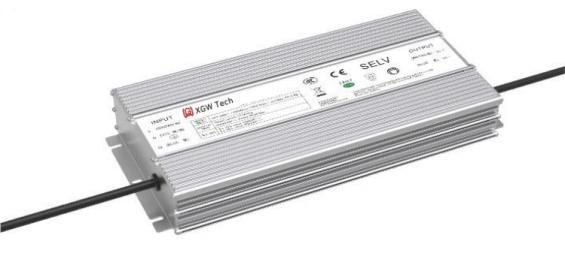
- We supplied two variants of the XGW LBV series IP67 constant-voltage driver: the LBV-200V048 (200 W, 48 V, 0 – 4.17 A) and the LBV-320V048 (320 W, 48 V, 0 – 6.70 A). The series is rated PF > 0.98, THD < 10% at full load and is built around an isolated constant-voltage topology that holds output within ±5% across the full load range.
- For the harsh barn environment, the LBV series ships with an aluminium sealed enclosure rated IP67, full input UVP plus output SCP / OVP / OPP / OTP, and DM 6 kV / CM 10 kV surge protection on the AC input. The same aluminium case also gives the thermal headroom needed to run continuously at elevated ambient.
- On the dimming side, the LBV series accepts a 0 – 10 V control signal directly. We tuned the dimming-to-output transfer curve with the integrator so the full-scale change in input voltage maps to a smooth, monotonic change in output — a small piece of firmware work, but it is what made the difference between the birds settling and the birds startling when the controller stepped the dimmer.
Specification Summary
| Item | Item | LBV-200V048 / LBV-320V048 (as supplied) |
|---|---|---|
| Topology | Isolated constant voltage | |
| Output voltage | 48 V DC (±5%) | |
| Output power | 200 W / 320 W | |
| Output current | 0 – 4.17 A / 0 – 6.70 A | |
| AC input | 176 – 264 V (100 – 277 V optional) | |
| Power factor | > 0.98 | |
| THD | < 10% | |
| Surge (DM / CM) | 6 kV / 10 kV | |
| Ingress protection | IP67 (sealed aluminium enclosure) | |
| Protection | Input UVP, output SCP / OVP / OPP / OTP | |
| Dimming | on/off, 0-10V, Triac, DALI, DMX512 optional | |
| Typical efficiency | 93.0% (200W) / 93.5% (320W) | |
| Warranty | 5 years | |
Results
- Both wattages ran continuously in the integrator's test barn through a full flock cycle without thermal trip or driver failure.
- Smooth 0-10V dimming was confirmed at the integrator's bench with a step-and-hold test: no visible flicker, no output overshoot on the 1-10 V transitions, and a monotonic output across the full control range.
- Number of barns and total driver count in service (project confidential, a few hundred units)
- Continuous operation hours without failure in the integrator's fleet (request under NDA)
Related Product
Case Study FAQ
Why does the dimming curve matter for poultry lighting?
Broilers react to sudden changes in light level with stress behaviour — crowding, pecking, and reduced feeding. Welfare standards (and integrator best practice) require the light to ramp gradually over the day, simulating dawn and dusk. A dimmer that snaps or overshoots defeats that. A smooth, monotonic 0-10V transfer curve is what makes a 0-10V controller actually behave like one.
Why IP67 for a barn environment?
Ammonia and humidity from bedding and respiration attack unsealed electronics, and the high-pressure wash-down cycles between flocks would destroy a non-IP67 driver mounted near the ceiling. A sealed aluminium enclosure with the cable entries potted keeps the converter outside the barn atmosphere.
Why 48 V rather than 24 V or 12 V?
Long LED strip runs in a barn mean long DC cables. 48 V halves the cable current versus 24 V at the same power, which halves the voltage drop on the cable and lets the integrator run longer runs from a single driver. It is also a SELV-friendly voltage when the strip side is treated as such.
Can the same driver support DALI or DMX if the integrator upgrades?
Yes — the LBV series accepts on/off, 0-10V, Triac, DALI and DMX512 dimming from the same enclosure. An integrator moving to a DALI-2 or DMX-based lighting control system can use the same driver without changing the field wiring on the AC side.
More Reading
- Choosing an IP67 LED Driver: 7 Specs That Actually Matter
- C&I Microgrid ESS for Tropical Heat and Humidity in Peru
- Smart Street Lighting Solution
Items marked in yellow are placeholders — replace them with the real project figures before publishing.