
384V 100Ah LiFePO4 UPS Battery for a Data Center in South Africa
The Challenge
- South Africa's grid supply has been subject to rolling blackouts for years. That single fact changes how a data center UPS battery has to be specified: the bank is not being sized for occasional short events, but for repeated deep discharges followed by short recharge windows — the duty cycle that wears VRLA out fastest.
- Because outage schedules are not fully predictable, the battery also has to be ready to deliver rated energy at any moment, rather than needing a warm-up or recalibration cycle first.
- Alongside that, the UPS host needed visibility into the battery: state of charge, state of health and alarms. Without BMS-to-UPS communication the operations team is working blind between site visits.
The Solution
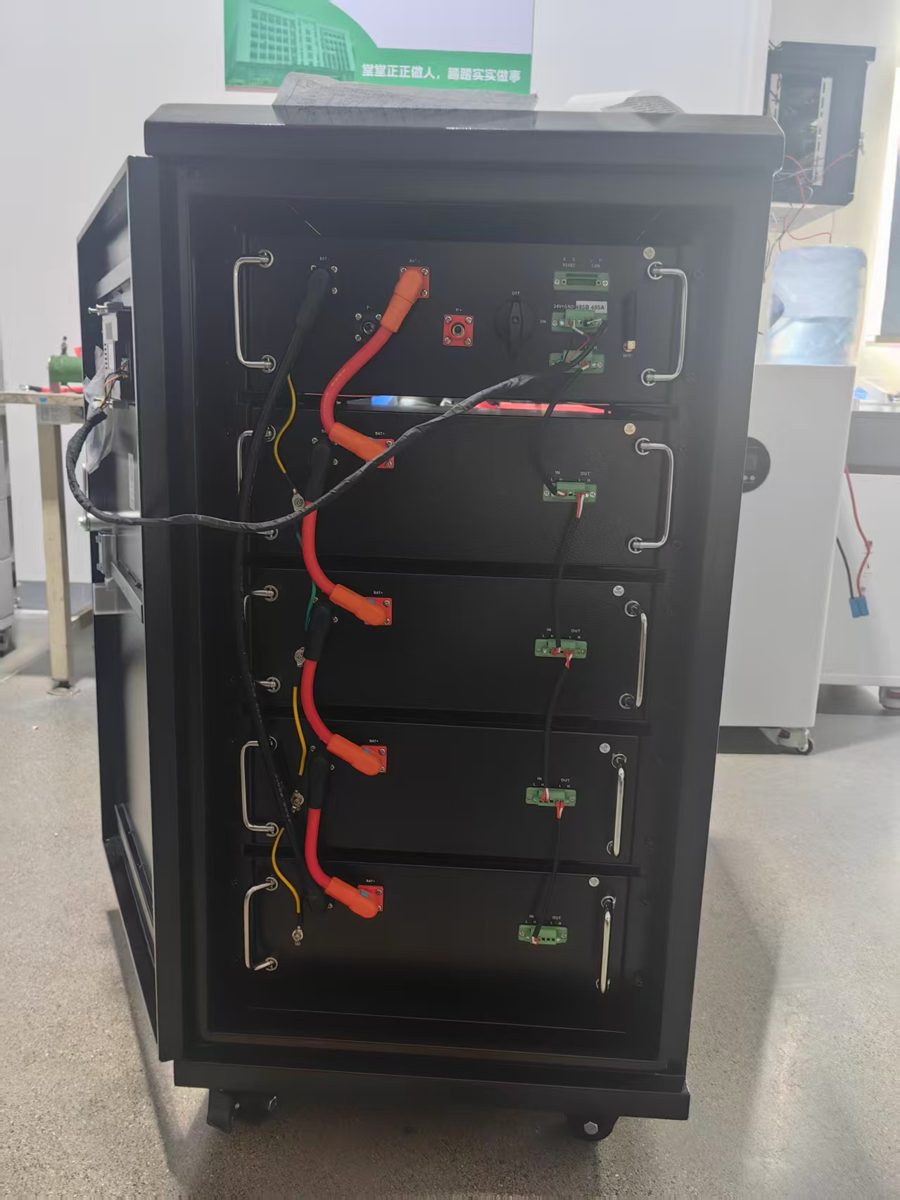
- We supplied a 384V 100Ah LiFePO4 string (120 cells in series, 38.4 kWh per string). LiFePO4 delivers several times the deep-cycle throughput of VRLA at the same nominal capacity, which is what a repeatedly-cycled battery actually consumes.
- Matching the UPS communication protocol was the requirement the customer cared about most. The BMS was configured for the host's protocol (Modbus RTU/TCP over RS485, CAN available), so the UPS reads SOC and SOH directly and the monitoring platform receives cell-level alarms as they occur.
- Charge acceptance is the third piece: the pack takes high current through most of the charge curve, so it returns to full readiness during short grid availability windows instead of trailing VRLA's long absorption tail.
VRLA Baseline vs LiFePO4
| Item | Typical VRLA bank | LiFePO4 as supplied |
|---|---|---|
| Chemistry | VRLA lead-acid | LiFePO4 |
| Nominal voltage | 384V DC | 384V DC (120S LiFePO4) |
| Capacity | 100 Ah | 100 Ah (38.4 kWh per string) |
| Deep-cycle endurance | Degrades with repeated deep discharge | Several times the deep-cycle throughput of VRLA |
| Recharge behaviour | Long absorption tail | High charge acceptance, ready again sooner |
| Communication with UPS host | Terminal voltage sensing only | Modbus over RS485, CAN optional |
Results
- Commissioned in April 2024 with a total installed capacity of 60 kWh.
- The bank is sized to the operator's required runtime. Ride-through is set by site load — and because the UPS now receives real state-of-charge data, that runtime figure is calculated rather than estimated.
- Charge acceptance is what matters between events: the pack returns to readiness during short grid windows instead of trailing a long absorption phase.
Related Product
Case Study FAQ
Why does frequent grid outage favour LiFePO4 over VRLA?
Deep cycling is what wears a battery out. VRLA tolerates a limited number of deep discharges before capacity drops off; LiFePO4 delivers several times that cycle count, so a site that discharges often wears through a VRLA bank far faster.
Does the UPS need to be replaced as well?
Not normally. If the nominal voltage band, charge behaviour and communication protocol are matched, the LiFePO4 string drops into the existing UPS. We configure the BMS to the host's protocol rather than asking the customer to change equipment.
How fast does the battery recharge between outages?
Much faster than VRLA. LiFePO4 accepts high charge current through most of the charge curve, so the pack returns to full readiness during short grid availability windows instead of waiting out a long absorption phase.
What data does the UPS receive from the battery?
State of charge, state of health, individual cell voltages, temperatures and alarm states — enough for accurate runtime prediction and for the monitoring platform to raise faults before they become outages.