
384V 100Ah LiFePO4 UPS Battery for a Data Center in Saudi Arabia
The Challenge
- A data center UPS installation in Saudi Arabia running on VRLA strings. Gulf ambient temperatures regularly reach 45-50℃, and VRLA life roughly halves for every 8-10℃ above its 25℃ rating — so strings sized for a five-year service life were failing well before that.
- The second issue was communication. The UPS host could not read the battery's state of charge, state of health or cell-level alarms, so the battery was treated as an unknown load: runtime estimates stayed conservative and fault detection depended on periodic manual checks.
- Battery replacement also had to happen without taking the protected load offline, which ruled out a long commissioning window.
The Solution
- We supplied a 384V 100Ah LiFePO4 battery string — 120 cells in series, 38.4 kWh per string — built to drop into the UPS DC bus voltage window. The string is a direct replacement for the existing VRLA bank: same nominal voltage band, same cabinet footprint, no change to the UPS itself.
- The part the customer cared about most was protocol matching. Our BMS was configured to speak the UPS host's protocol (Modbus RTU/TCP over RS485, with CAN as an alternative), so the UPS reads real SOC, SOH, cell voltages, temperatures and alarm states directly. Runtime prediction becomes accurate, and alarm thresholds are handled by the UPS rather than by a separate panel.
- For the thermal side, the enclosure uses high-temperature-tolerant cells with a BMS that derates charge current as cell temperature rises, plus active ventilation. The result is a pack that tolerates Gulf ambients instead of ageing out of them.
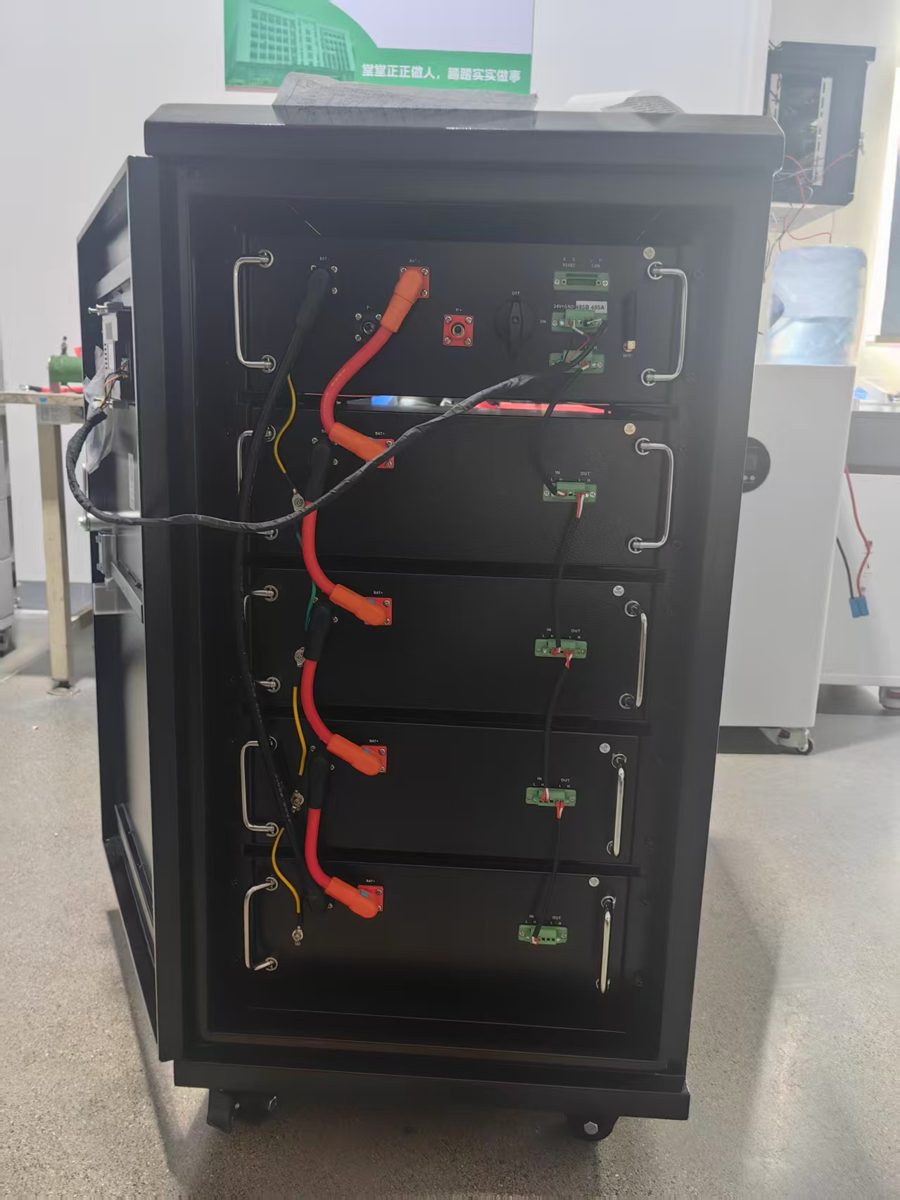
VRLA Baseline vs LiFePO4
| Item | Typical VRLA bank | LiFePO4 as supplied |
|---|---|---|
| Chemistry | VRLA lead-acid | LiFePO4 |
| Nominal voltage | 384V DC | 384V DC (120S LiFePO4) |
| Capacity | 100 Ah | 100 Ah (38.4 kWh per string) |
| Communication with UPS host | Terminal voltage sensing only | Modbus RTU-TCP over RS485, CAN optional |
| Data available to UPS | Terminal voltage only | SOC, SOH, cell voltage, cell temperature, alarms |
| Behaviour at 45-50℃ ambient | Accelerated ageing, capacity fade | BMS-managed, charge current derated by temperature |
Results
- Commissioned in August 2025 with a total installed capacity of 200 kWh.
- The installation is engineered for Gulf ambient temperatures: the BMS derates charge current as cell temperature rises, which is the behaviour that protects cycle life through sustained heat.
- Because the BMS speaks the UPS host's protocol, battery state is reported straight into the UPS and monitoring platform — no separate battery panel to maintain.
Related Product
Case Study FAQ
Why is the UPS battery voltage 384V?
384V DC is a common DC-bus voltage for mid-to-large UPS systems. In LiFePO4 terms it is 120 cells in series (120 x 3.2V nominal = 384V), which lets the pack replace a VRLA string of the same nominal voltage without modifying the UPS.
Can a LiFePO4 string replace VRLA without changing the UPS?
Usually yes, provided three things match: the nominal voltage band, the charge profile the UPS expects, and the communication protocol. We configure the BMS to the host's protocol so the UPS recognises the pack and can report SOC and alarms.
What happens if the BMS and UPS protocols do not match?
The UPS treats the battery as an unmanaged load. Runtime estimates fall back on conservative defaults and cell-level faults are not reported to the monitoring system — which is exactly the gap protocol matching closes.
How does high ambient temperature affect the two chemistries?
VRLA life drops sharply above its 25℃ design point — the common rule of thumb is roughly halved life for every 8-10℃ rise. LiFePO4 tolerates higher temperatures far better, and the BMS protects the pack by derating charge current as cell temperature climbs.