
Zhaga Book-18 Socket
Screwless IP66 interface with three controller tiers
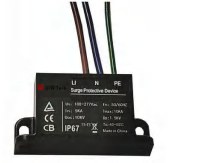
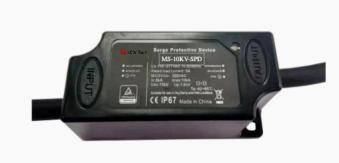
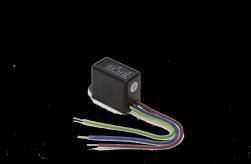
XGW builds surge protective devices around a GDT + MOV hybrid with a thermal disconnect, so end of life is a controlled open circuit rather than a short to earth. Three series cover luminaire-internal, distribution-panel and pole-top duty, all type-tested on the IEC 61643-11 combination wave.
Request Quote & Data Sheet WhatsApp Us| Standard | IEC 61643-11; UL 1449 (MK series) |
|---|---|
| Device types | Type 1, Type 2, Type 1+2 |
| Ratings | 10 kV / 5 kA and 20 kV / 10 kA |
| Protection modes | L-N, L-PE and N-PE depending on series |
| Technology | GDT + MOV hybrid with thermal disconnect |
| Mounting | Luminaire internal, panel / DIN rail, pole-top |
Three mounting positions, three device types — sized to where the surge actually enters the installation.
| Series | Type | Models | Imax | Modes | Mounting | Standard |
|---|---|---|---|---|---|---|
| MS | Type 2 | MS-10KV / MS-20KV | 10 kV / 5 kA | L-N, L-PE | Luminaire internal | IEC 61643-11 |
| MK | Type 1+2 | MK-20KV / MK-10KV | 20 kV / 10 kA | L-N, L-PE, N-PE | Panel / DIN rail | IEC 61643-11 · UL 1449 |
| ML | Type 1 | ML-20KV / ML-10KV | 20 kV / 10 kA | L-N, L-PE | Pole-top | IEC 61643-11 |
MS is installed inside the luminaire or pole junction box and protects the LED driver from induced transients. MK is a combined Type 1+2 device for distribution boards feeding lighting circuits, where critical LED and control electronics sit downstream. ML mounts at the pole top and handles direct lightning current at the point of exposure, before it reaches the luminaire.
All three are type-tested on the 1.2/50 µs and 8/20 µs combination wave — not a single-wave bench figure — and every GDT + MOV stack includes a thermal disconnect.
Luminaire-internal Type 2 protection for city roads and residential streets, protecting the driver from induced transients.
High-power surge protection with dimming control for highways, tunnels and bridges where exposure is high and access is costly.
Combined Type 1+2 devices on boards feeding lighting circuits, protecting critical control electronics.
Type 1 devices mounted at the top of the pole, handling direct lightning current before it reaches the luminaire.
Type 1 devices are tested for direct lightning current and are typically installed at the point of exposure, such as a pole top. Type 2 devices handle induced transients and are installed inside equipment or at distribution boards. A Type 1+2 device is tested for both and suits distribution panels feeding lighting circuits.
It depends on the exposure. For most street lighting, a Type 2 device inside the luminaire or pole junction box protects the driver. Where lightning exposure is direct, a Type 1 device at the pole top handles the current before it reaches the luminaire, and a combined Type 1+2 device at the distribution board protects everything downstream.
It takes the device out of circuit in a controlled way at end of life. Without it, a degraded MOV can fail as a short to earth. With it, end of life is a controlled open circuit — which is the failure mode you want on a street lighting network.
Match the rating to the exposure class of the site. Sheltered urban streets are normally served by 10 kV / 5 kA; exposed routes, elevated sites and regions with high lightning activity justify 20 kV / 10 kA.
The MK series carries UL 1449 recognition in addition to IEC 61643-11. All series are type-tested on the IEC combination wave; full test reports are available on request.
The smart lighting accessories catalogue covers the NEMA and Zhaga platforms, the SPD range, certification standards and reference deployments across 50+ countries.
Screwless IP66 interface with three controller tiers
Twist-lock receptacles including the JL-250F with integrated SPD
20-600W waterproof driver for outdoor luminaires